Seeing People – Seeing Potential

City Business Women

Think about the countless people you encounter each day…

…At the coffee shop.

…In the checkout line.

…During work.

…At the playground with your kids.

…Around the neighborhood.

…In your home.

Now ask yourself, “Do I really see these people as valuable individuals, or do I see them simply as figures passing through my day?” It’s easy to become focused on what we need to accomplish and miss the very present opportunity to interact and engage with the people in our path.

Several years ago, I was getting out of my car for an event at the Dallas Arboretum. The valet recognized me and said she had read some of my books. Trust me, this doesn’t happen very often, so understandably I wanted to visit with her. That encounter at the car led to an opportunity to mentor this positive and gifted young woman, and we are close friends to this day.

What made that connection work? It began by opening our eyes. She saw me as more than just a customer, but rather as a possible mentor. I saw her as more than a valet – I saw a smart girl filled with great enthusiasm and potential. What do you see as you observe the people around you?

How do we open our eyes to the treasure in others? What are some practical ways we can train our eyes to see beyond the immediate? Here are a few tips:

  1. Strengthen your observation skills. Every time I’m in an airport waiting for my flight, I enjoy watching the people shuffling by me. I try to figure out where they are going and why, simply by observing what they are wearing or carrying. I employ a bit of imagination, but this little game helps me to pay attention to the details and improves my vision. Every person has a purpose or a reason for their journey, it takes a watchful eye to truly see.
  2. Know their name. Savvy customer service companies are keenly aware of the power of a name. A thank you goes a whole lot further when it is accompanied by the person’s name and a smile. Often the name is easy to find because someone is wearing a name tag or handing you a credit card. If the name is not so obvious, introducing yourself only takes a moment. Use a name twice, then make a mental note of it, and you are more likely to remember it next time. Earl Nightingale put it this way, “Of all things people want, recognition is number one. And recognition means a name. It’s the sweetest sound a person can hear, even though you’ll never get them to admit it.”
  3. Ask a question. The right question, at the right time can unveil a possible connection, a future opportunity or even a deep hurt or need. Recently, I was buying flowers at the grocery store and the customer next to me pushed aside the veil of isolation by saying, “Those are beautiful flowers. Are they for a special occasion?” What a great way to open up a conversation, when normally we would just stand there looking at our phones, waiting for our turn at the register. Questions are keys to unlock conversation and can be as simples as, “How are you doing today?” Or what about asking a waitress or a teacher or an Uber driver, “How can I pray for you?”

I know it’s a challenge for each of us to slow down, take our eyes off our agenda and pay attention to the people around us. Yet at the end of the day, what is more valuable than investing in another person’s life. It takes just a little extra effort to really see the person in front of us and care about his or her story, and certainly the reward is worth it. When we think about every individual as a beautiful creation of God, rather than just simply someone we pass on the street, it changes our perspective and makes every encounter shine brightly with potential.
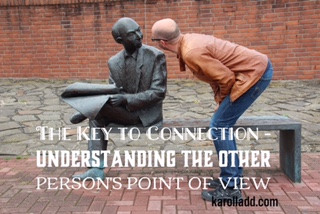

Perspective – The Key to Connection

perspective

Have you ever had one of those awkward times when you felt misunderstood? Recently, while visiting with a colleague, I made a simple suggestion that would typically be warmly received – but not in this case. She snapped back and accused me of judging her, yet condemnation was the farthest thing from my mind. It was then that I had to step back and look at the bigger picture. What made her react in such a protective manner? What nerve did I hit? Why did my simple words rattle her?

When I considered things from her perspective and thought about her current situation, and the little I knew about her childhood, my heart softened and I understood why she responded the way she did. Initially I felt misunderstood, but the resolution came when I attempted to understand the issue from her point of view. Perhaps the greatest need that we as humans have is not only be loved, but to be understood. Choosing to see things from another person’s perspective can not only build connection, but can also reconcile our own feelings of being misunderstood.

This is especially true when it comes to client relations or customer service. When an unkind customer comes to you with an angry complaint, instead of taking it personally, choose to see things from their perspective. Ask yourself:

• Why is this so important to them?
• What could have happened during their day today to make them this angry?
• What’s going on in their personal life that is affecting their attitude right now?
• Are they like this all of the time? Are they a negative person by nature?

Sometimes, I even take it a step further and think about what their childhood may have been like and what kind of hurt or abuse they endured in their life. When we go the extra mile to see past the exterior anger, we can often find an opportunity to open the door of communication. When encountering conflict of any sort whether personal or in business, it helps to selflessly begin the conversation with statements such as:

• Help me understand what you are saying.
• Tell me why you feel this way.
• Let me make sure I hear what you are saying.
• What is it that is making you frustrated?
• In what way can I help resolve this?

Let’s push forward this week to build understanding with the people we encounter. Step into the other person’s perspective and be a thoughtful listener rather than a reactive participant. Ask God to give you His patience, kindness and self-control as you interact with the people around you. Most important, remember that you are loved and understood by the God who sees all and knows your heart.

thrive Thrive, Don’t Simply Survive: Passionately Living the Life You Didn’t Plan

5 Power Words That Can Impact a Life

Donna parla con lettere su sfondo bianco

Our words matter. They can encourage someone to push forward in life using his or her gifts and abilities, or they can tear down an individual, producing discouragement and bitterness. Last week we talked about the difference between constructive criticism and a critical spirit. As we continue our series on building connections with others, we will take a look this week at ways our words can have a positive impact and possibly change the trajectory of someone’s life.

Think about a time when a person’s words deeply mattered to you. Most of us can quickly remember the negative impact someone’s words had on us, but hopefully we can also recall a few powerfully positive words that helped us along life’s way. My dad, Garry Kinder, was a constant source of encouragement to me. His words pushed me to move forward and do my best. He helped me recognize that God gave me unique gifts and talents to be used in this world. His words energized me to persevere through tough times.

I want to offer you five words that can have a positive and powerful impact on the people around you. Use them sincerely and specifically – not artificially or as flattery. Although they are simple, they can be used to move mountains. Give these words as a gift to others, helping them reach their God-given potential.

See – I see your effort. I see your ability. I see how gifted you are.  I see what you are going through.

Believe – I believe you can do this. I believe God has equipped you. I believe you have the strength.

Able – I know you are able to persevere. You are able to accomplish it. God is able to help you.

Strong – You are stronger than you think. God is your strength. Here are the strengths I see in you.

Love –  I love the way you use your gifts. I love being around you. I love seeing God work in your life.

Of course the most powerful phrase in the human language is, “I love you.” Use it wisely, but use it often toward those who are dear to you. Solomon said, “Death and life are in the power of the tongue.” How will you use your words this week to lift up another person’s life?


The Power of What You Don’t Say

Businesswomen have a break

What if I told you the secret to effective communication is not about what you say, but rather what you don’t say? Now, don’t get me wrong – our words matter, but that’s not all that matters when it comes to getting our message across to others. Research shows that 55% of our communication is non-verbal. Yes, our body language conveys more than our words when it comes to engaging with people. Whether we are trying to build a positive connection with clients, customers, students or friends, our non-verbal communication should work for us and not against us. Here are three powerful keys to unlock the door to productive communication:
1. The Power of a Smile. It may seem simplistic, but it’s not! A smile speaks a thousand words. It says, “I care about you. I believe in you. I’m listening.” It welcomes others and makes them feel comfortable around us. It speaks confidence, openness and understanding. Even in phone conversations, evidence reveals that a smile makes a difference in attitude and perception. Now you may be thinking, but I don’t feel like smiling. Remember, a smile is not for you, it is a gift you give to other people. When we smile, it actually raises the serotonin level in our brain (that’s the happy hormone). So smiling can actually make us happier people! People carry around too many of their own challenges to be burdened with our frown. Give the gift of a smile to uplift others. Practice smiling with your eyes, and your lips will surely follow.
2. Essential Eye Contact. Just as our eyes are an endearing part of our smile, they are also play a vital role in strengthening the message we want to communicate. It’s easy for all of us to get distracted by other people or things (like our phones), but deliberate focus takes discipline and determination. It means that we are going to demonstrate with our eyes that the person we are talking to is the most important person in the room. In a highly distractible culture, we can learn to ignore the temptation to look at all the diversions swirling around us. How do you do it? As with anything in life, practice, practice, practice. Begin to build the skill of focusing, by concentrating in conversation with at least one person each day, even if the only person you see is the checkout person at the grocery store. Make yourself a sticky note and put it on your mirror to remind yourself to smile and focus each day. You will see a vast improvement in your relationships with family, friends and customers as you let your eyes do more of the talking.
3. Positional Impact. Recently at a restaurant, my husband sat down at our table and promptly turned his chair to face away from me. No, he wasn’t mad at me. He was experiencing sciatic nerve pain, so it was more comfortable for him to point in the other direction – at least that’s what he told me! After a few minutes, I moved around to the other side of the table in order for him to be positioned toward me and not away from me. It made a difference! I went from feeling ignored, to feeling seen and heard. Body language and position expresses how interested we are in the other person. A waitress who faces each customer is speaking volumes by her stance. A teacher who turns toward her students and pays attention to them, gets her message across with greater impact than a teacher who sits at her desk or hides behind a podium. Pay attention to what you are saying through your position and direction. Think about how it would feel if you were on the receiving end. Are you inviting others into your world or are you saying, “I could care less about you?” Parents, let’s think about the way we engage with our children and demonstrate love through not only our smile and eye contact, but the way we stoop down and listen to our little ones.
Take these three keys and use them to strengthen your connections with the people around you. Practice giving the people around you the gift of your smile. Concentrate on eye contact with at least one person each day, and turn your body toward the people with whom you are communicating. Never underestimate the power of what you don’t say.


Thrive, Don’t Simply Survive: Passionately Living the Life You Didn’t Plan

Look for the Possibilities

Great opportunities come to all, but many do not know they have met them. The only preparation to take advantage of them is simple fidelity to watch what each day brings.  Albert E. Dunning

12377584_10102575454021383_4012495737842196173_o


It seems a bit ironic that a visually impaired woman would encourage others to have focus and vision. Helen Keller didn’t let her challenges keep her from looking at the possibilities in her own life. Born in 1880, Helen became both blind and deaf at nineteen months of age due to a childhood illness, yet she was the first blind and deaf woman to earn a Bachelor of Arts degree and authored a dozen books and numerous other writings. In her book We Bereaved she wrote, “When one door of happiness closes, another opens; but often we look so long at the closed door that we do not see the one which has been opened for us.”

Where are you looking? Have you allowed your eyes to zoom in on the frustrations that are right in front of you, making them seem larger than life? Or are you looking at the bigger broader picture – the picture that includes possibilities and hope? There are always possibilities around the corner, but we need to be looking for them instead of dwelling on what we don’t have. I like to say that the “B” in Plan B stands for beautiful. Often we think our Plan A was the perfect plan and that Plan B is second rate. Have you ever considered that Plan B is God’s Plan A and He can do a great work despite our disappointments and even our mistakes?

It may be difficult to conceive in your mind that anything good could come from hurt, pain and loss whether it is a physical, financial or a family tragedy in your life. We must be honest and grieve through the sadness that life brings. We don’t want to ignore our disappointment and hurt in our heart, but we also don’t want to close our mind’s eye to the redemption God can bring in the toughest of situations.  It may take time and perseverance. Plan B may be difficult, but it doesn’t mean it isn’t doable. Perhaps the “B” in Plan B means “Be patient.” Allow God to do His work in His way, and do not despair for there is always hope.

Read more in Positive Life Principles for Women