Eyes That See Beyond

Nek Chand fantasy rock garden, Chandigarh

In the middle of the city of Chandigarh, India, is a quite unusual garden. It is an amazing testament to the artistic value of trash. That’s right, trash. Celebrated artist Nek Chand used materials people discarded as trash and formed them into an artistic wonder called the Rock Garden. Chand considers it an expression of his hope for humanity. While others may look at trash as a problem that needs to be hidden away, the artist saw it in a different way. He saw the trash as objects that could be creatively transformed into art.

“It all started out of personal curiosity,” says Chand, who started building the garden in the 1950s using urban and industrial waste. He began by clearing a little patch of jungle in order to create a small garden area for himself. He collected boulders, metal pieces, lag stones, overburned bricks, broken pots, chinaware, rags, plastic dolls, battered hats, broken bangles, shoes, bottles, you name it! All of it was used in his work to transform trash into a grand mosaic of treasure and beauty. There was no limit to what he could envision and create out of the trash.

Gradually his creative art display developed and grew, eventually covering several acres that displayed hundreds of sculptures. For the first eighteen years of his project, he had to work in the secrecy of night, fearing he would be discovered by the authorities. The funny thing is, when the government officials did discover the garden, they were confused as to how to handle the situation. The art garden was illegally built on a forbidden area, which meant they had the right to demolish it, but they recognized its beautiful and unique qualities. So instead of demolishing the sculpture garden, the city decided to give Chand a salary to allow him to work on the garden full time. They even provided a workforce of fifty laborers. The garden was finally opened to the public in 1976. Today there are more than twenty-five acres with thousands of sculptures set in large mosaic courtyards, linked by walled paths and deep gorges. There is also a series of interlinking waterfalls.

The Rock Garden is now admired as one of the modern wonders of the world and is considered one of the greatest artistic achievements seen in India since the Taj Mahal. Currently they have more than five thousand visitors a day. Carl Lindquist, who works with the international program at Arkansas State University, described it this way, “Built of industrial waste and thrown-away items, the Rock Garden in the city of Chandigarh is perhaps the world’s most poignant and salient statement of the possibility of finding beauty in the unexpected and accidental.”


Amazing! Objects that were once considered trash were turned into a beautiful work of art. I love Lindquist’s phrase “finding beauty in the unexpected and accidental.” Nek Chand didn’t see trash; he saw treasure. That’s what God sees in our lives! He holds the broken pieces of our life in his hands and fits them into a beautiful mosaic for eternity. We may see a mess here, a mistake there, a tragic loss, or an unfortunate incident, but God sees potential. Singularly a piece of trash isn’t so lovely, but like Chand, God sees the wonderful work that can be formed. As we draw close to him and hear his voice, we begin to hear the whisper of the Master Artist saying, Trust me. I can make something good come from this.


This is an excerpt from Thrive, Don’t Simply Survive

thrive


What Makes a Great Leader?

Child superhero portrait

Over the years, I’ve become fairly perceptive at recognizing qualities that make a poor leader. It’s probably because I’ve placed one too many people in leadership positions, and realized they were doing more harm than good. Thankfully we can learn and grow from our mistakes. Here’s my short list of characteristics of a not-so-great leader.
Generally speaking it’s not a good idea to choose a person for leadership who:
• Tends to gossip or look down on others.
• Complains rather than finds solutions.
• Has no initiative and can’t make decisions.
• Doesn’t work well with people.
• Is a discourager rather than an encourager.
• Is self-centered – in it for themselves.
• Is constantly wondering what people think about them.
• Has an aversion to hard work and serving others.
• Lacks determination and drive.

What would you add to the list? It’s easy to think up a list of negative qualities born out of our own experiences, but it takes a little more thought and insight to come up with a list of positive leadership qualities. One characteristic that seems to surface in great leaders is their ability to motivate others. For some, this intangible ability to inspire and influence seems to come naturally, while other leaders discover their ability to impassion people through the School of Hard Knocks. How can we unleash our inner influence and ability to inspire?

In his book, Visioneering, Andy Stanley described a great leader in the Bible, Nehemiah: “He was just a regular guy who caught a divine glimpse of what could and should be. And then went after it with all his heart.” In reading the story of Nehemiah, there are several themes that continue to surface again and again. These seem to be the key to Nehemiah’s inspiring leadership abilities. I would encourage you as a leader to read the story of Nehemiah yourself and discover the powerful lessons of his life. Here’s the principles I glean from his example:
• He possessed a personal and heart-felt passion for the project.
• He was committed to the mission and determined to see it through.
• He was persistent despite the challenges.
• He sincerely cared about the protection and well-being of the people.
• He appealed to people’s hearts and core motivation, not just the external.
• He put the right people in the right positions, utilizing their gifts and talents.
• He wasn’t swayed by the opposition or people’s opinions.
• He empowered the people to do their jobs well.
• He prayed for God’s direction throughout every twist and turn.

We can all use an example to inspire and teach us when it comes to leadership. Nehemiah is one of my heroes. Who inspires and teaches you?

Positive Leadership Principles for Women: 8 Secrets to Inspire and Impact Everyone Around You

By Karol Ladd / Harvest House Publishers

As a woman you have the chance to make a positive difference in your family, community, and society. In Positive Leadership for Women Karol Ladd uses examples from the lives of people in the Bible to highlight eight godly leadership principles and attitudes that will inspire you to grow in your role as a godly influencer.

Seeing People – Seeing Potential

City Business Women

Think about the countless people you encounter each day…

…At the coffee shop.

…In the checkout line.

…During work.

…At the playground with your kids.

…Around the neighborhood.

…In your home.

Now ask yourself, “Do I really see these people as valuable individuals, or do I see them simply as figures passing through my day?” It’s easy to become focused on what we need to accomplish and miss the very present opportunity to interact and engage with the people in our path.

Several years ago, I was getting out of my car for an event at the Dallas Arboretum. The valet recognized me and said she had read some of my books. Trust me, this doesn’t happen very often, so understandably I wanted to visit with her. That encounter at the car led to an opportunity to mentor this positive and gifted young woman, and we are close friends to this day.

What made that connection work? It began by opening our eyes. She saw me as more than just a customer, but rather as a possible mentor. I saw her as more than a valet – I saw a smart girl filled with great enthusiasm and potential. What do you see as you observe the people around you?

How do we open our eyes to the treasure in others? What are some practical ways we can train our eyes to see beyond the immediate? Here are a few tips:

  1. Strengthen your observation skills. Every time I’m in an airport waiting for my flight, I enjoy watching the people shuffling by me. I try to figure out where they are going and why, simply by observing what they are wearing or carrying. I employ a bit of imagination, but this little game helps me to pay attention to the details and improves my vision. Every person has a purpose or a reason for their journey, it takes a watchful eye to truly see.
  2. Know their name. Savvy customer service companies are keenly aware of the power of a name. A thank you goes a whole lot further when it is accompanied by the person’s name and a smile. Often the name is easy to find because someone is wearing a name tag or handing you a credit card. If the name is not so obvious, introducing yourself only takes a moment. Use a name twice, then make a mental note of it, and you are more likely to remember it next time. Earl Nightingale put it this way, “Of all things people want, recognition is number one. And recognition means a name. It’s the sweetest sound a person can hear, even though you’ll never get them to admit it.”
  3. Ask a question. The right question, at the right time can unveil a possible connection, a future opportunity or even a deep hurt or need. Recently, I was buying flowers at the grocery store and the customer next to me pushed aside the veil of isolation by saying, “Those are beautiful flowers. Are they for a special occasion?” What a great way to open up a conversation, when normally we would just stand there looking at our phones, waiting for our turn at the register. Questions are keys to unlock conversation and can be as simples as, “How are you doing today?” Or what about asking a waitress or a teacher or an Uber driver, “How can I pray for you?”

I know it’s a challenge for each of us to slow down, take our eyes off our agenda and pay attention to the people around us. Yet at the end of the day, what is more valuable than investing in another person’s life. It takes just a little extra effort to really see the person in front of us and care about his or her story, and certainly the reward is worth it. When we think about every individual as a beautiful creation of God, rather than just simply someone we pass on the street, it changes our perspective and makes every encounter shine brightly with potential.

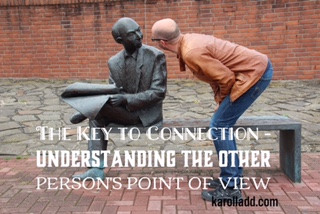
Perspective – The Key to Connection

perspective

Have you ever had one of those awkward times when you felt misunderstood? Recently, while visiting with a colleague, I made a simple suggestion that would typically be warmly received – but not in this case. She snapped back and accused me of judging her, yet condemnation was the farthest thing from my mind. It was then that I had to step back and look at the bigger picture. What made her react in such a protective manner? What nerve did I hit? Why did my simple words rattle her?

When I considered things from her perspective and thought about her current situation, and the little I knew about her childhood, my heart softened and I understood why she responded the way she did. Initially I felt misunderstood, but the resolution came when I attempted to understand the issue from her point of view. Perhaps the greatest need that we as humans have is not only be loved, but to be understood. Choosing to see things from another person’s perspective can not only build connection, but can also reconcile our own feelings of being misunderstood.

This is especially true when it comes to client relations or customer service. When an unkind customer comes to you with an angry complaint, instead of taking it personally, choose to see things from their perspective. Ask yourself:

• Why is this so important to them?
• What could have happened during their day today to make them this angry?
• What’s going on in their personal life that is affecting their attitude right now?
• Are they like this all of the time? Are they a negative person by nature?

Sometimes, I even take it a step further and think about what their childhood may have been like and what kind of hurt or abuse they endured in their life. When we go the extra mile to see past the exterior anger, we can often find an opportunity to open the door of communication. When encountering conflict of any sort whether personal or in business, it helps to selflessly begin the conversation with statements such as:

• Help me understand what you are saying.
• Tell me why you feel this way.
• Let me make sure I hear what you are saying.
• What is it that is making you frustrated?
• In what way can I help resolve this?

Let’s push forward this week to build understanding with the people we encounter. Step into the other person’s perspective and be a thoughtful listener rather than a reactive participant. Ask God to give you His patience, kindness and self-control as you interact with the people around you. Most important, remember that you are loved and understood by the God who sees all and knows your heart.

thrive Thrive, Don’t Simply Survive: Passionately Living the Life You Didn’t Plan

5 Power Words That Can Impact a Life

Donna parla con lettere su sfondo bianco

Our words matter. They can encourage someone to push forward in life using his or her gifts and abilities, or they can tear down an individual, producing discouragement and bitterness. Last week we talked about the difference between constructive criticism and a critical spirit. As we continue our series on building connections with others, we will take a look this week at ways our words can have a positive impact and possibly change the trajectory of someone’s life.

Think about a time when a person’s words deeply mattered to you. Most of us can quickly remember the negative impact someone’s words had on us, but hopefully we can also recall a few powerfully positive words that helped us along life’s way. My dad, Garry Kinder, was a constant source of encouragement to me. His words pushed me to move forward and do my best. He helped me recognize that God gave me unique gifts and talents to be used in this world. His words energized me to persevere through tough times.

I want to offer you five words that can have a positive and powerful impact on the people around you. Use them sincerely and specifically – not artificially or as flattery. Although they are simple, they can be used to move mountains. Give these words as a gift to others, helping them reach their God-given potential.

See – I see your effort. I see your ability. I see how gifted you are.  I see what you are going through.

Believe – I believe you can do this. I believe God has equipped you. I believe you have the strength.

Able – I know you are able to persevere. You are able to accomplish it. God is able to help you.

Strong – You are stronger than you think. God is your strength. Here are the strengths I see in you.

Love –  I love the way you use your gifts. I love being around you. I love seeing God work in your life.

Of course the most powerful phrase in the human language is, “I love you.” Use it wisely, but use it often toward those who are dear to you. Solomon said, “Death and life are in the power of the tongue.” How will you use your words this week to lift up another person’s life?