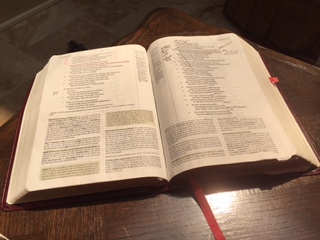
Throughout the centuries there have been skeptics and mockers of the Bible, and none so vehement as the French philosopher Voltaire. He applied his gift of writing in an attempt to demolish Christianity, believing that when people became enlightened they would no longer believe in God, or the Bible or their need for salvation through Jesus Christ. He is quoted as saying of Christ, “Curse the wretch!” Obviously Voltaire had some serious anger issues, not to mention a tad bit of arrogance. He boasted, “In twenty years, Christ will be no more. My single hand shall destroy the edifice it took twelve apostles to rear.”
Voltaire died in 1778, and since his death, millions upon millions of Bibles have been printed and sold throughout the entire world. This man who said that he would expose the Bible and that it would be buried in obscurity is dead and gone, but the Word of God stands forever. Ironically, sometime after his death, Voltaire’s house was purchased by the Geneva Bible Society and was used as a warehouse for Bibles. The Holy Scriptures survived Voltaire, and they will continue to survive despite modern-day critics and outspoken atheists.
Jesus said, “Heaven and earth will pass away, but my words will never pass away” (Matthew 24:35). Peter described the Bible as “living and enduring” (1 Peter 1:23). Isaiah penned, “The grass withers and the flowers fall, but the word of our God endures forever” (Isaiah 40:8). The Bible is an indestructible book. Many besides Voltaire have attempted to do away with it. In AD 303, the Roman emperor Diocletian issued an imperial decree that every Bible should be destroyed. Many Bibles were burned and Christians were put to death for having them in their possession, yet this holy book endured! Even in the Middle Ages, when the Bible was kept from the common people, men such as John Wycliffe and William Tyndale risked their lives to translate the Scriptures so that all could have access to reading it.
Modern-day critics of the Bible question its accuracy, and claim that it couldn’t possibly be the same document as the original manuscripts. Perhaps you have wondered how we can know that the Bible is true, accurate, and infallible. In this blog we will investigate the process of how we got what we know today as the Word of God, the Holy Scriptures, the Bible. We will also look at the questions some people have about errors or contradictions. Why is it important for us to investigate the veracity of the Bible? Because it claims to be the very words of God, and if it is, then we must lean our whole life into it. It is our foundation, and we must be able to stand on it with confidence.
How Did the Bible Come Together?
The Bible has over 40 authors who were divinely inspired to write the Scriptures. Not only are the Scriptures themselves God-breathed, but we can see that God led the process by which the books were chosen. Knowing how the Bible came together offers beautiful evidence that God wants His people to know about His love, and He communicated His message of love through the Holy Scriptures.
Of course volumes could be written on the history of this amazing book, but in this section we will deal specifically with the accuracy of the manuscripts. One word we need to understand before we begin is the word canon which comes from a Greek word meaning “measuring stick” or “reed.” In other words, a canon was a measuring rod. The word eventually came to refer to those books that were “measured” and hence recognized as being God’s Word and part of the Holy Scriptures.
The Hebrew Scriptures (which we know as the Old Testament), were written from approximately 1400 BC to 400 BC. Most of the Old Testament was recorded in the Hebrew language (with several passages in Aramaic) and was passed down by the Jewish people from generation to generation. From the time of their writing, the Jewish people accepted them as the authentic, inspired Word of God. From 400 BC to Christ’s birth, several other books made their way into the popular culture of the Jewish people. These are known as the Apocrypha.[i] While most of the Jewish scholars did not accept the Apocrypha as Holy Scriptures, they valued them as good literature and as sources of history and spiritual insight. Some Roman Catholic Bibles still contain the writings of the Apocrypha.
Moses, the prophets, and the other Old Testament writers were recognized by the Jews as God’s messengers and accepted their work as inspired of God. The Old Testament canon was essentially established by the time of Jesus’ birth. Around 90 AD, Jewish elders met together at what is known as the council at Jamnia, and confirmed the Hebrew canon while rejecting the books of the Apocrypha. Several years later, a Jewish historian and priest named Flavius Josephus recognized the Hebrew canon as the books that we now have in the Old Testament. Jesus quoted passages from the Old Testament, including Psalms, Deuteronomy, and Isaiah, knowing His listeners recognized these books as Scripture. By the mid-third century, the church was in almost complete agreement about the Hebrew canon of Scripture.
Old Testament Accuracy
Skeptics often criticize the Bible, saying that a book claiming to be thousands of years old certainly has inaccuracies or errors, but recent archaeological evidence again and again supports that what we have today is reliable and accurate. Looking back at the Old Testament we know that the Israelites kept the copy of the Book of the Law (the first five books of the Old Testament written by Moses) inside the ark of the covenant, stored in the temple. Despite the fact that the Babylonians destroyed the temple, the Scriptures were preserved. While in Babylonian captivity certain Levites (members of the priestly tribe of Levi) began copying the Scriptures and circulating them to other Israelites in captivity.
These Levites became known as scribes, and were respected for their attention to the Scripture and their accuracy in copying them. The scribes painstakingly transcribed each copy of the Law and developed a meticulous process to copying the manuscripts by hand, in order to prevent any errors. The scribes recognized that they were handling the very Word of God and wanted to handle each word, each letter with the utmost care. Some of the rules they followed were:
- Parchments and all materials had to be made according to strict specifications and could only come from the skins of clean (kosher) animals.
- The quills had to come from clean birds and the black ink had to be prepared to scribal specifications.
- Even if the scribe had memorized it, no word or letter could be written from memory. The scribe was required to copy every word from an authentic copy of Scripture.
- Before writing the name of God, a scribe was required to reverently wipe his pen and say, “I am writing the name of God for the holiness of His name.”
- Each letter had to have space around it. If one letter even touched another or if a letter was not written correctly or defective due to a hole, a tear, or a smudge causing it not to be read easily, the scroll was invalidated.
- Within 30 days of completion, the manuscript would be reviewed by an editor who counted every letter and every word as a way of checking. The editor even made sure that the middle word of the copy matched the middle word of the original.
- Up to three mistakes on any page could be corrected within 30 days, but if more mistakes were found or if they were not fixed in 30 days, the entire manuscript had to be buried (manuscripts containing the name of God could not be destroyed). If a single letter was added or left off, the manuscript had to be fixed or buried.[ii]
This careful and detailed process of copying the Hebrew Scriptures in ancient times is what has led to the accuracy of our Old Testament today. Probably one of the most significant discoveries confirming the reliability of our Old Testament Scriptures is known as the Dead Sea Scrolls. In 1947, while throwing rocks into a cave, a herdsman in Qumran near the Dead Sea accidentally discovered hidden writings of the Essene community (an ancient Jewish sect). Since that time, thousands of fragments, which belonged to more than 800 manuscripts, have been discovered.
Before these scrolls were found, the earliest known manuscript of the Old Testament was dated at around AD 980, but The Dead Sea scrolls were estimated to date back to 150 BC! A thousand years earlier! Yet, the two sets of manuscripts are essentially the same with only a few minor variations. The scrolls include a well-preserved copy of the whole book of Isaiah and have proved to be word-for-word identical with our Hebrew Bible in more than 95 percent of the text. The remaining 5 percent is almost entirely due to spelling variations or slips of the pen. Larry Stone, author of The Story of the Bible (a fascinating book by the way—a must-have), writes, “The Dead Sea Scrolls provide astonishing confirmation that the Old Testament Scripture we have today is virtually the same as that being read a few centuries before Christ. The accuracy of the transmission is remarkable!”[iii]
The New Testament Canon
What about the New Testament? The process of canonizing the New Testament started during the early years of the church, as the apostles’ writings were recognized as inspired and were continually read at church gatherings. Believers knew that the apostles were divinely appointed by God and gifted to communicate His message to the church. Each manuscript was handwritten (the literal meaning of manuscript) and very precious to the early believers. There were several reasons that a New Testament canon needed to be established. One reason was the persecution of the church. As believers faced torture, imprisonment or death for possessing the Scriptures, they needed to establish which books were sacred and worth risking their lives in order to preserve.
Also, there were spurious writings attributed to the apostles in widespread circulation throughout the first few centuries, so it was important for the early church leaders to determine which ones were divinely inspired by the Holy Spirit and should be recognized as Holy Scriptures. Although most of the books we now know as our New Testament were already being revered as Scripture, there were a few books that still needed to be examined. All along, we can see God’s hand in leading the divine process of revealing Himself through the written word of the New Testament. In AD 393 at the Synod of Hippo and in AD 397 at the Synod of Carthage, Christian leaders came together to confirm the 27 books of the New Testament. The word synod refers to a council or meeting of church leaders. The confirmation was not taken lightly. There were at least four general tests which were carefully used and applied to help determine the books to be canonized. They were:
- Apostolicity: Was the book’s author a true apostle or closely connected to one or more of the apostles?
- Universality: Does the body of Christ at large accept the book as inspired and authoritative? Was the book universally received by the church and not just by a faction?
- Consistency: Does the book tell the truth about God as it is already known by previous revelation? Is the book consistent with accepted Christian doctrine?
- Inspiration: Does the book’s content reflect the high moral and spiritual principles that would reflect a work of the Holy Spirit? Does the book give evidence of being divinely inspired? This was the ultimate test.
The Synod at Carthage only confirmed what the church had already recognized—that these 27 books were the divinely inspired Word of God. Biblical scholar F.F. Bruce wrote,
One thing must be emphatically stated. The New Testament books did not become authoritative for the Church because they were formally included in a canonical list; on the contrary, the Church included them in her canon because she already regarded them as divinely inspired recognizing their innate worth and generally apostolic authority, direct or indirect…What the synods of Hippo and Carthage did, was not to impose something new upon the Christian communities, but to codify what was already the general practice of those communities.[iv]
This blog is an excerpt from my book, Becoming a Woman of the Word.
[i] The books in the Apocrypha include 1 Esdras, 2 Esdras, Tobit, Judith, Wisdom of Solomon, Ecclesiasticus, Baruch, the Letter of Jeremiah, Prayer of Manasseh, 1 Maccabees, and 2 Maccabees.
[ii] Larry Stone, The Story of the Bible (Nashville, TN: Thomas Nelson Publishers, 2010), p. 21.
[iii] Stone, p. 27.
[iv] F.F. Bruce, The New Testament Books: Are They Reliable? (Grand Rapids, MI: William B. Eerdmans Publishing Co., 1981) p. 22.





 Positive Woman Connection